

The Recursive Breach: Why the Shadow Layer Is Cybersecurity’s New Silent Killer
Inside the invisible 80% of Cybersecurity damage spreading silently across the modern SupplyChain.

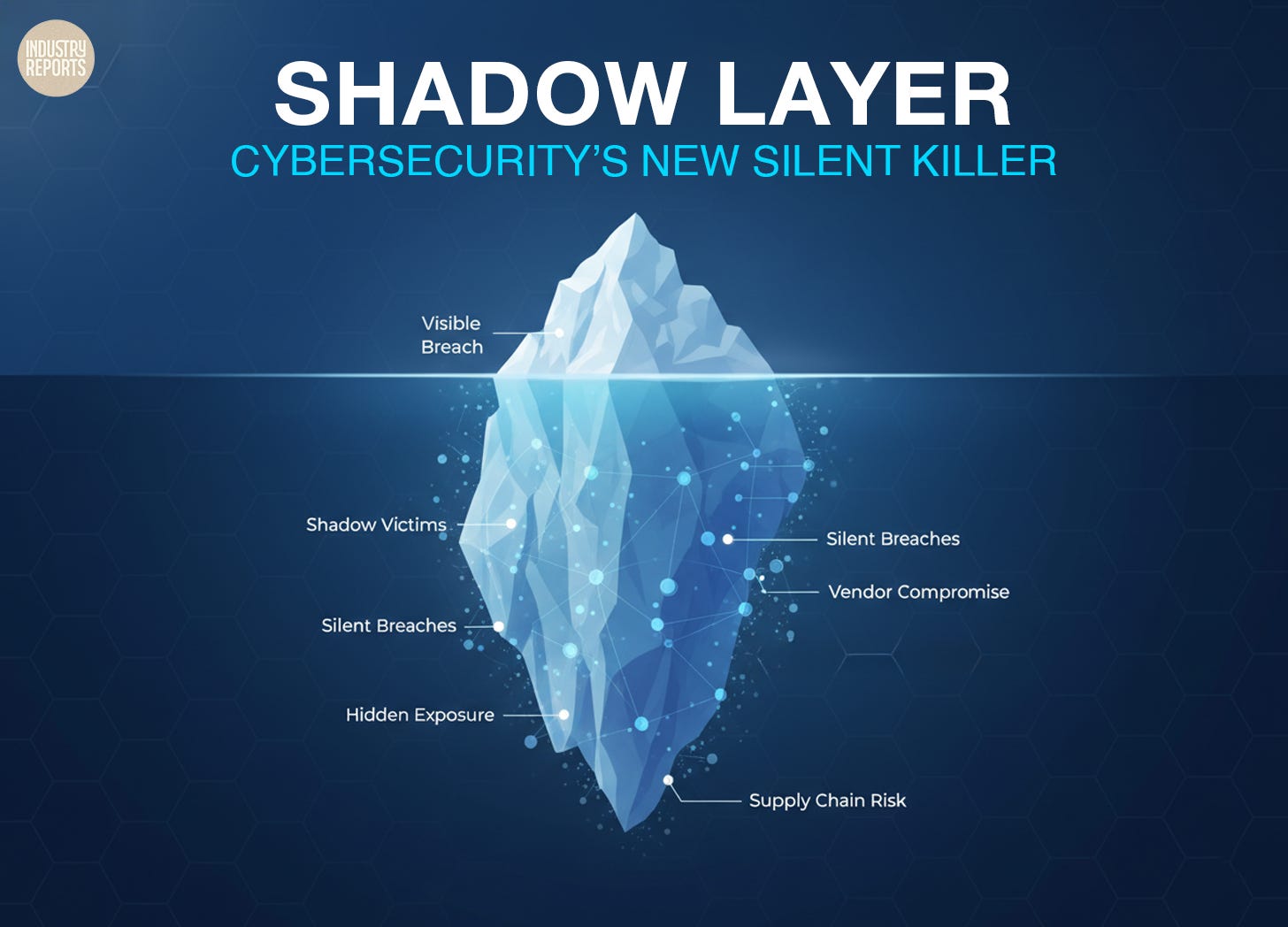
Imagine an iceberg floating in the vast ocean of cybersecurity. The visible 20% represents organizations that publicly disclose data breaches. These incidents dominate headlines, trigger regulatory investigations, and prompt immediate responses.
But beneath the surface lies the hidden 80% of an unseen network of affected companies that rarely appear in reports or news coverage. This concealed ecosystem is what cybersecurity experts increasingly refer to as the “Shadow Layer.”
For every organization that publicly announces a breach, several others remain unnamed and invisible, quietly absorbing the consequences of the same attack. These shadow victims endure operational disruptions, data exposure, and intellectual property theft without public acknowledgement. Understanding this hidden impact is critical to preserving the integrity of modern digital ecosystems.
So the real question is: how do organizations defend against threats they may not even realize they are part of?
The Visible Data Breach: Only the Tip of the Supply Chain Attack
When a major breach occurs, headlines usually focus on a single organization. A well-known example is the 2013 breach involving the retailer Target Corporation, where millions of customer records were compromised. The incident triggered investigations, lawsuits, and global media attention.
However, the attack did not begin inside Target’s systems. Hackers initially gained access through a third-party HVAC vendor connected to the retailer’s network. That small vendor became the entry point into a much larger ecosystem.
This pattern is common in modern cyberattacks. Once attackers compromise a single weak link in a digital supply chain, they can move laterally across interconnected partners, vendors, and service providers. Many of these affected companies remain silent, either because disclosure laws do not apply to them or because revealing the breach could damage business relationships.
Public reports therefore capture only a fraction of the true impact. While one company appears in headlines, multiple downstream organizations may quietly suffer the same compromise.
The Shadow Layer: Hidden Victims of Supply Chain Breaches
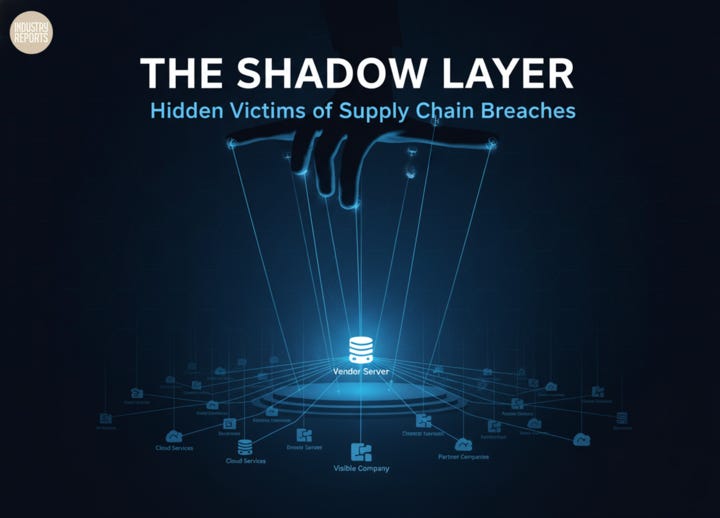
In cybersecurity, the Shadow Layer refers to the hidden network of organizations indirectly impacted by breaches that originate upstream in a supply chain or service provider.
Unlike primary breach victims, these companies often fall outside formal disclosure requirements. If the breach does not involve specific regulated data, organizations may not be legally required to notify regulators or customers.
As a result, many incidents remain invisible.
These shadow victims may still experience serious consequences, including:
Intellectual property theft
Operational disruptions
Unauthorized access to proprietary systems
Exposure of sensitive business data
But because the original breach occurred elsewhere - often at a vendor or platform provider, the affected companies may not even realise they were compromised.
This lack of visibility can create a dangerous illusion of security.
The Multiplier Effect of Cyber Breaches in Vendor Networks
Shadow breaches rarely stay contained. Instead, they create a multiplier effect across entire supply chains.
Modern organizations depend on a dense network of partners, SaaS providers, logistics platforms, and cloud services. A compromise at any central node in this network can ripple outward to dozens or even hundreds of connected companies.
Imagine a cloud provider hosting applications for hundreds of clients. If attackers gain access to that provider’s environment, every connected customer potentially becomes a secondary victim.

Cybersecurity expert Bruce Schneier once observed: “Security is a process, not a product.”
The breach therefore expands beyond the original target, creating a chain reaction of hidden exposure across multiple organizations.
This principle becomes especially relevant in interconnected ecosystems. Security can no longer be viewed as an isolated organizational responsibility — it must extend across the entire digital supply chain.
Why Compliance Audits Miss Hidden Supply Chain Breaches
Many organizations rely on vendor audits and compliance checks to evaluate supply chain security. Unfortunately, these processes are often designed primarily to confirm regulatory compliance, not to detect hidden breach propagation.
Audits typically verify whether vendors:
follow encryption standards
maintain security policies
meet compliance frameworks such as General Data Protection Regulation or California Consumer Privacy Act
While important, these checks do not always reveal whether a vendor was previously compromised or whether a breach has silently spread across connected systems.
As Schneier also warns: “Complexity is the enemy of security.”
The more complex and interconnected digital supply chains become, the harder it is to detect indirect breaches. Companies may pass compliance audits while still being vulnerable to unseen compromises within their partner networks.
AI and Autonomous Systems: Expanding Cybersecurity Risks in Supply Chains

Artificial intelligence is rapidly transforming business operations, from supply chain optimization to automated decision-making. But these technologies also introduce new pathways for shadow breaches to spread.
AI platforms often process enormous volumes of shared data across multiple organizations. If an attacker compromises one component of such a system, the resulting breach can propagate through automated processes before security teams even detect the intrusion.
Consider an AI-driven supply chain platform used by dozens of companies to coordinate logistics and inventory. If attackers infiltrate that platform, they may gain access not just to one organization’s data but to the entire network connected to the system.
Automation can therefore accelerate both efficiency and risk. Without strong monitoring and oversight, AI systems may unintentionally amplify the spread of cyber intrusions across interconnected ecosystems.
Conclusion: The Hidden Cybersecurity Risks of the Shadow Layer
The Shadow Layer exposes a largely invisible dimension of cybersecurity risk. For every publicly reported breach, numerous organizations may be silently affected through shared vendors, platforms, and digital supply chains.
Traditional audits and compliance frameworks were not designed to uncover these hidden connections. As organizations adopt more complex technologies — including cloud infrastructure and AI-driven systems — the potential for unseen breach propagation continues to grow.
To address this reality, companies must move beyond reactive breach response and toward continuous ecosystem monitoring. Security strategies must account not only for direct attacks but also for the hidden ripple effects that spread across partner networks.
Because in modern cybersecurity, the biggest threat is often not the breach you see.
It’s the one lurking beneath the surface.